
For professionals
Designed with occupational therapists, speech therapists and special-education teachers.
Evotonomia is not reinventing the wheel: it carries well-established practices from cabinets and special-education classrooms onto mobile. Your professional perspective is central during this observation phase.
Positioning
Who, with whom, what for.
A clear matrix to situate the tool before using it, and to spell out what it deliberately is not.
Who it is for
Children with autism spectrum disorder (ASD), specific learning disorders, language disorders, or supported in special education. Also relevant as a structuring tool for any child who needs stable visual anchors.
With whom
Always paired: the child and a referring adult (parent, occupational therapist, speech and language therapist, educator, special-education teacher). The adult builds, the child executes.
What it is for
Breaking a task into visual steps, structuring the day, supporting transitions, encouraging success through positive reinforcement. Three anchors: task analysis, Fitzgerald colour code, TEACCH schedules.
What it is not
Not a mainstream gamification app. Not a substitute for professional follow-up. Not an autonomous rehabilitation tool: the adult retains control over content, evaluation and adjustment.
A typical use
Three actors, one routine, one tool.
A speech and language therapist builds the “leaving for school” routine with an 8-year-old child with ASD: seven steps illustrated by Fitzgerald pictograms, in strict order, triggered every morning. The mother validates the steps one by one with the child. The therapist reviews progress and notes at the weekly appointment, and exports the planner as a PDF for printing at home.
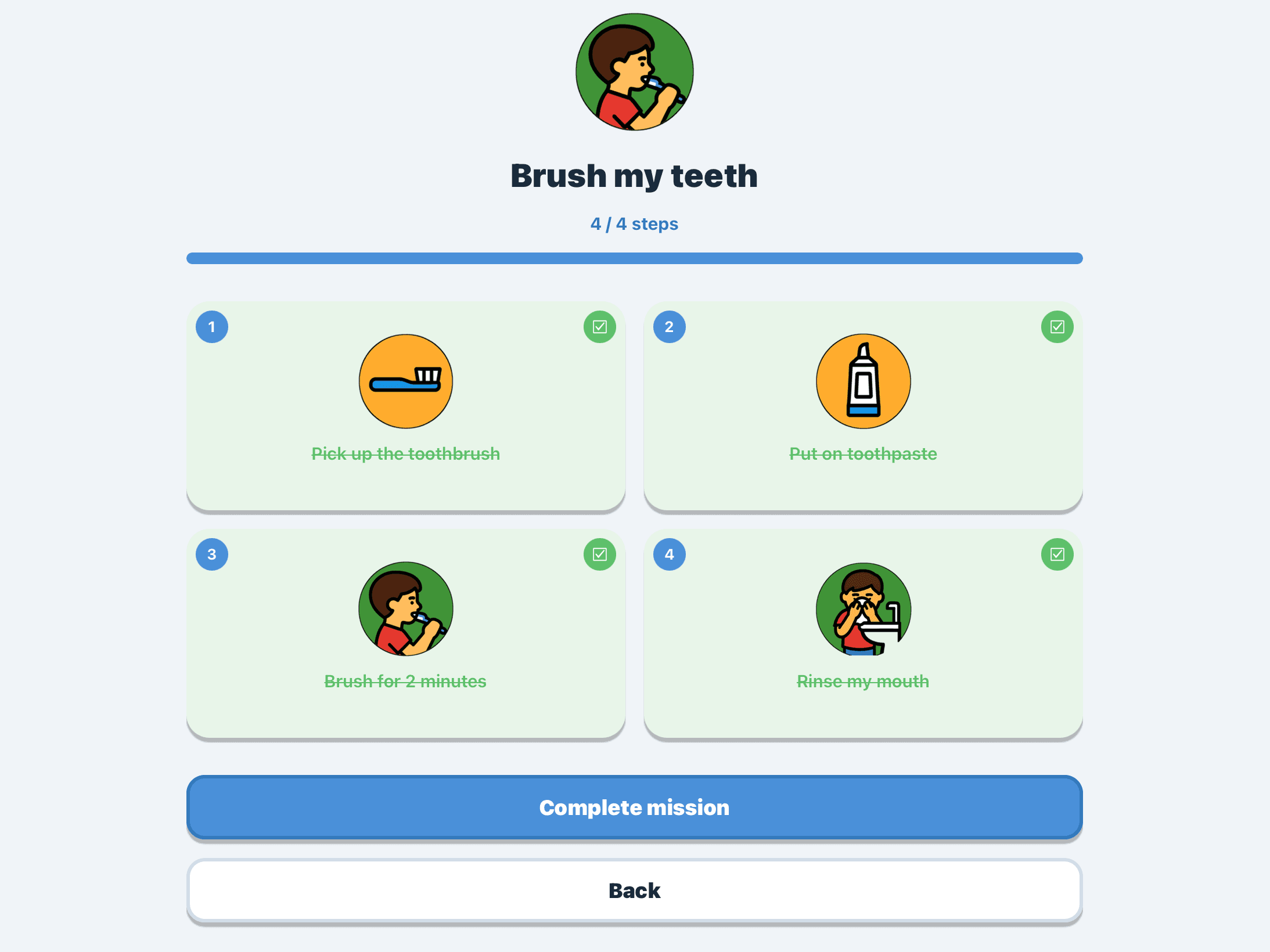
Three professions
Three professions, one tool.
Speech and language therapists
Sequential breakdown of routines, pictogram vocabulary aligned with AAC principles, configurable missions for joint follow-up in session and at home. PDF export of the planner for family / clinic communication.
Occupational therapists
Task analysis built into the tool, exportable visual schedules, habituation sequences on real-life routines, pictograms normalised along the Fitzgerald colour code. Adaptable to each child's sensory and motor profile.
Special-education teachers
Shared visual planner, predictable transition frames, fine-grained per-child settings, fully offline mode, no dependency on classroom Wi-Fi. A natural fit for special-needs classrooms, inclusive settings and medical-educational institutes.
Built-in pro tooling
What is built into the pro side.
Beyond routines, the app embeds follow-up tools designed to fit into an OT, SLT, medical-educational or special-needs classroom file.
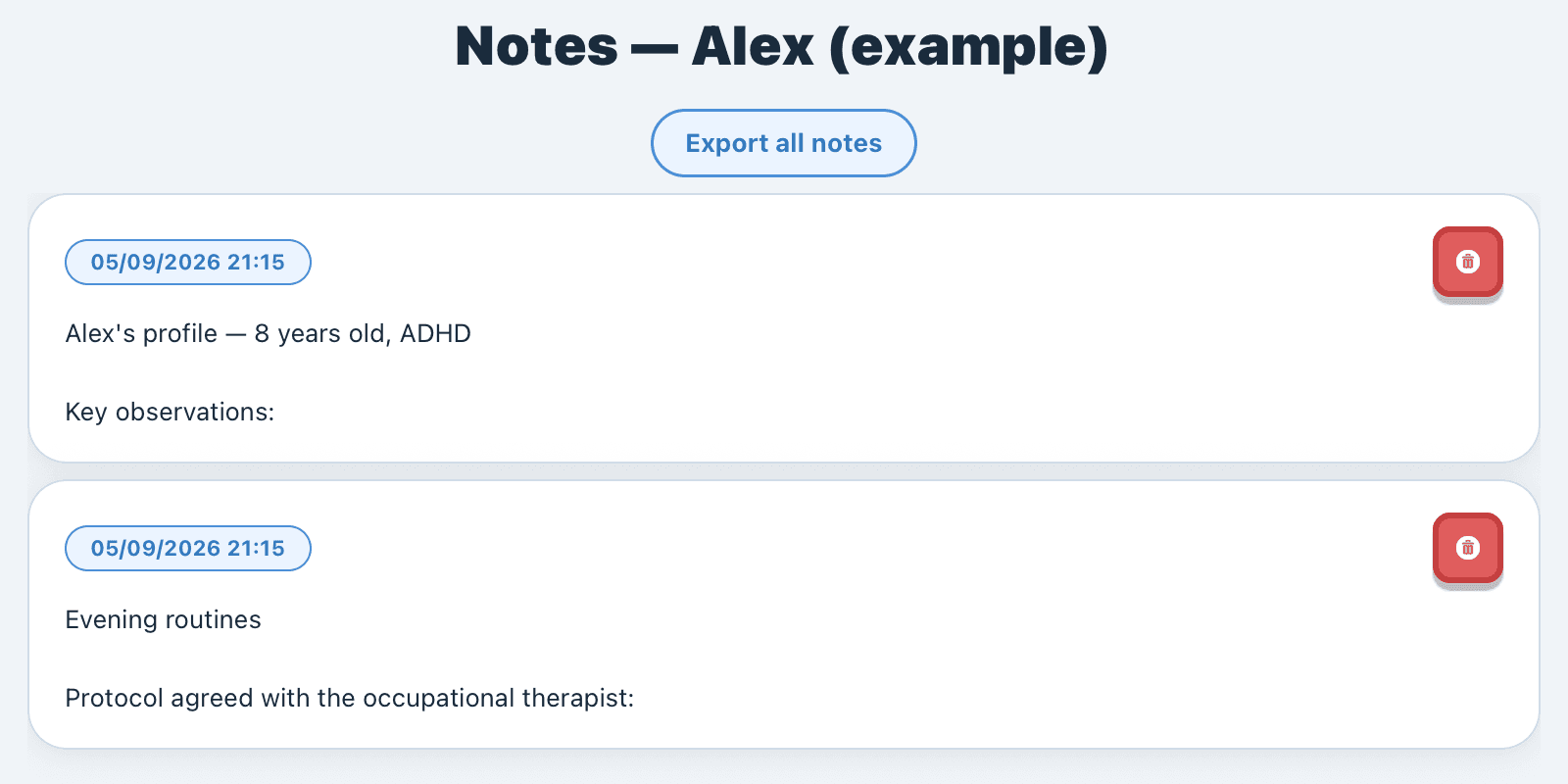
Follow-up notes
Free-form, timestamped logbook, exportable as structured plain text. For recording triggers, attempted adjustments, daily wins, and points to discuss. Compatible with an external follow-up file.
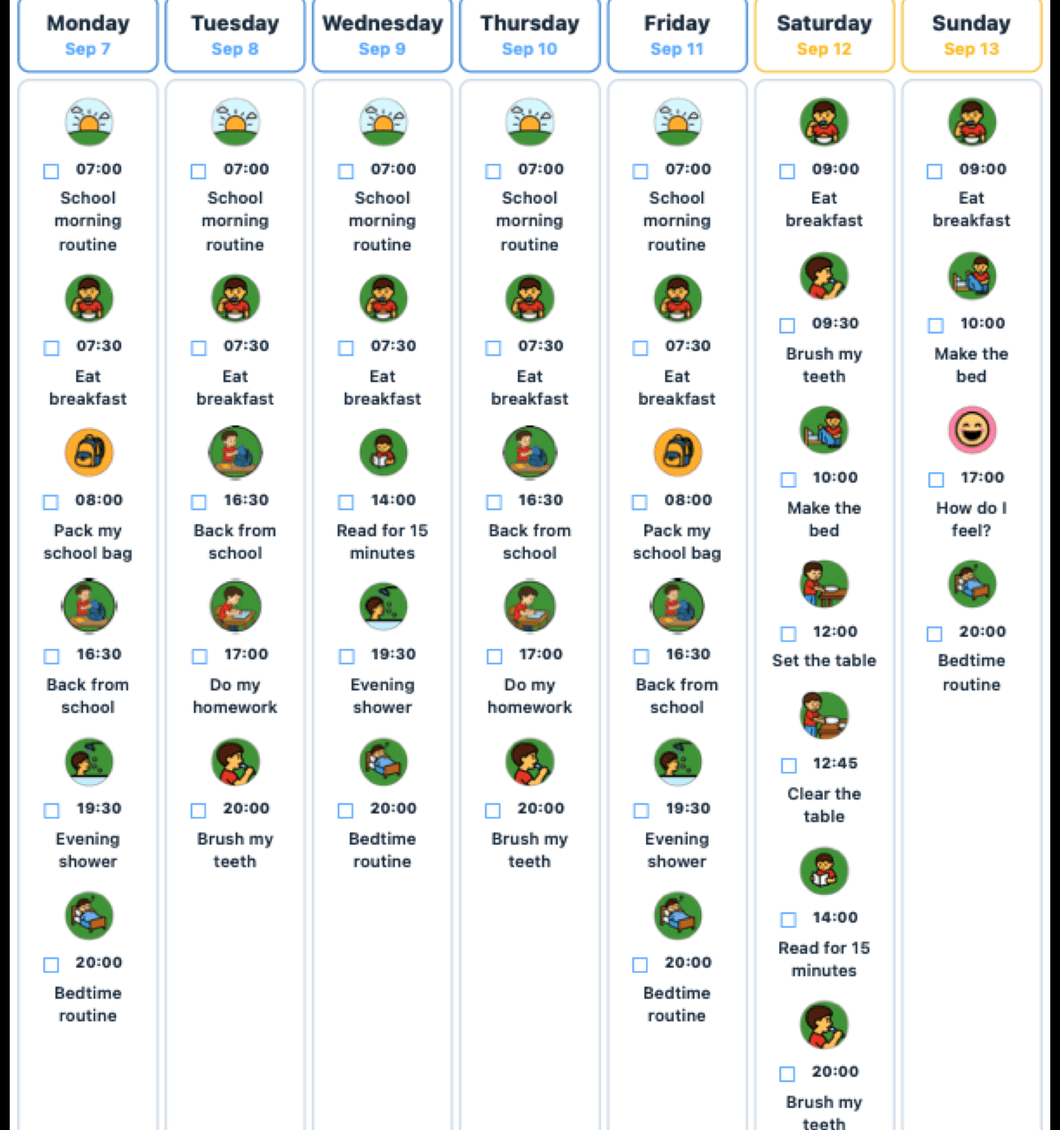
Planner PDF export
The weekly planner exports as a printable PDF. Checkboxes, time slots, Fitzgerald pictograms. Typical use: home display or paper support in the classroom.
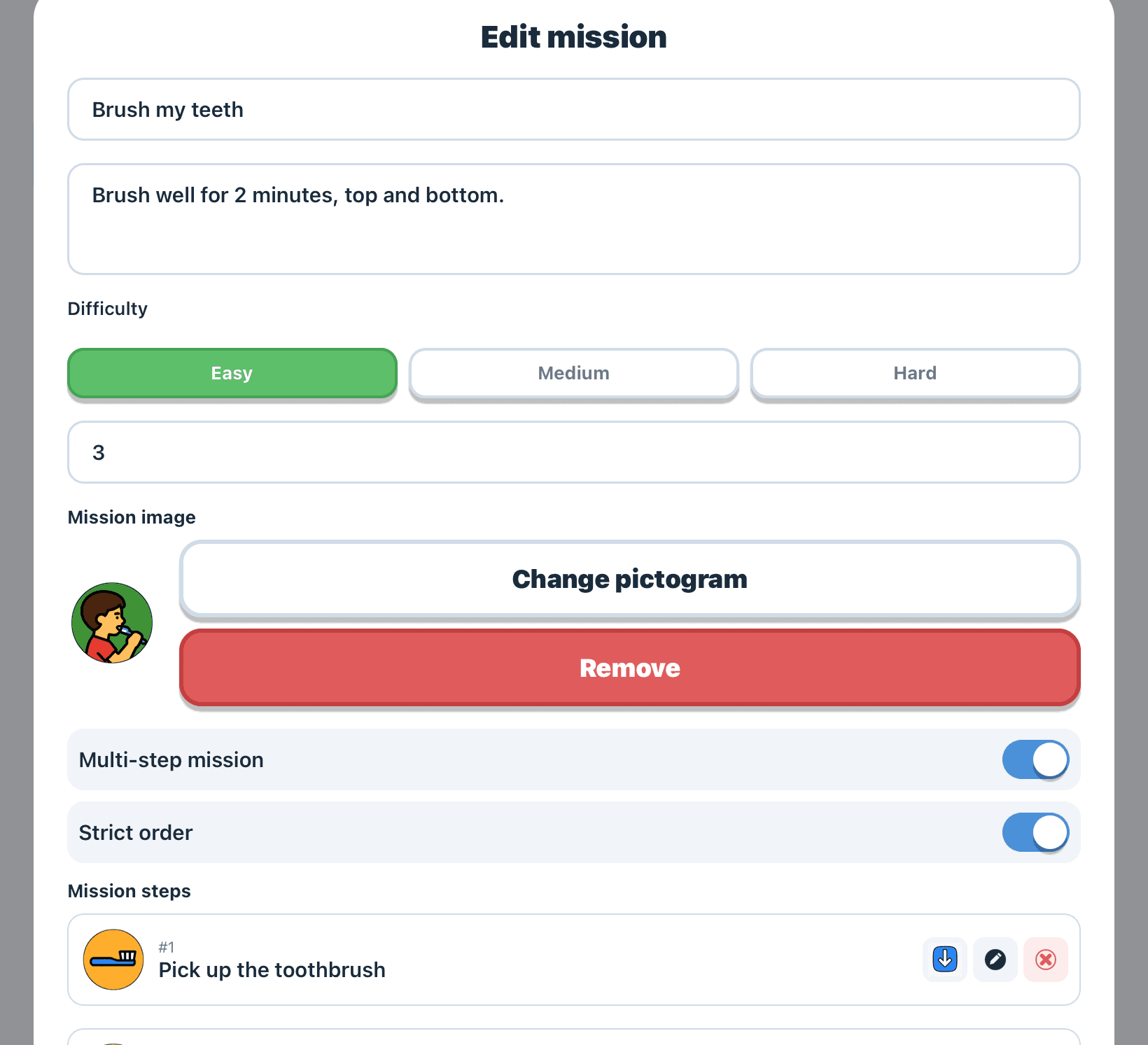
Three-lever mission editor
Difficulty (informative, modulates points), timer (visible countdown), strict or free order. All settings on a single screen: under two minutes to produce a working mission.
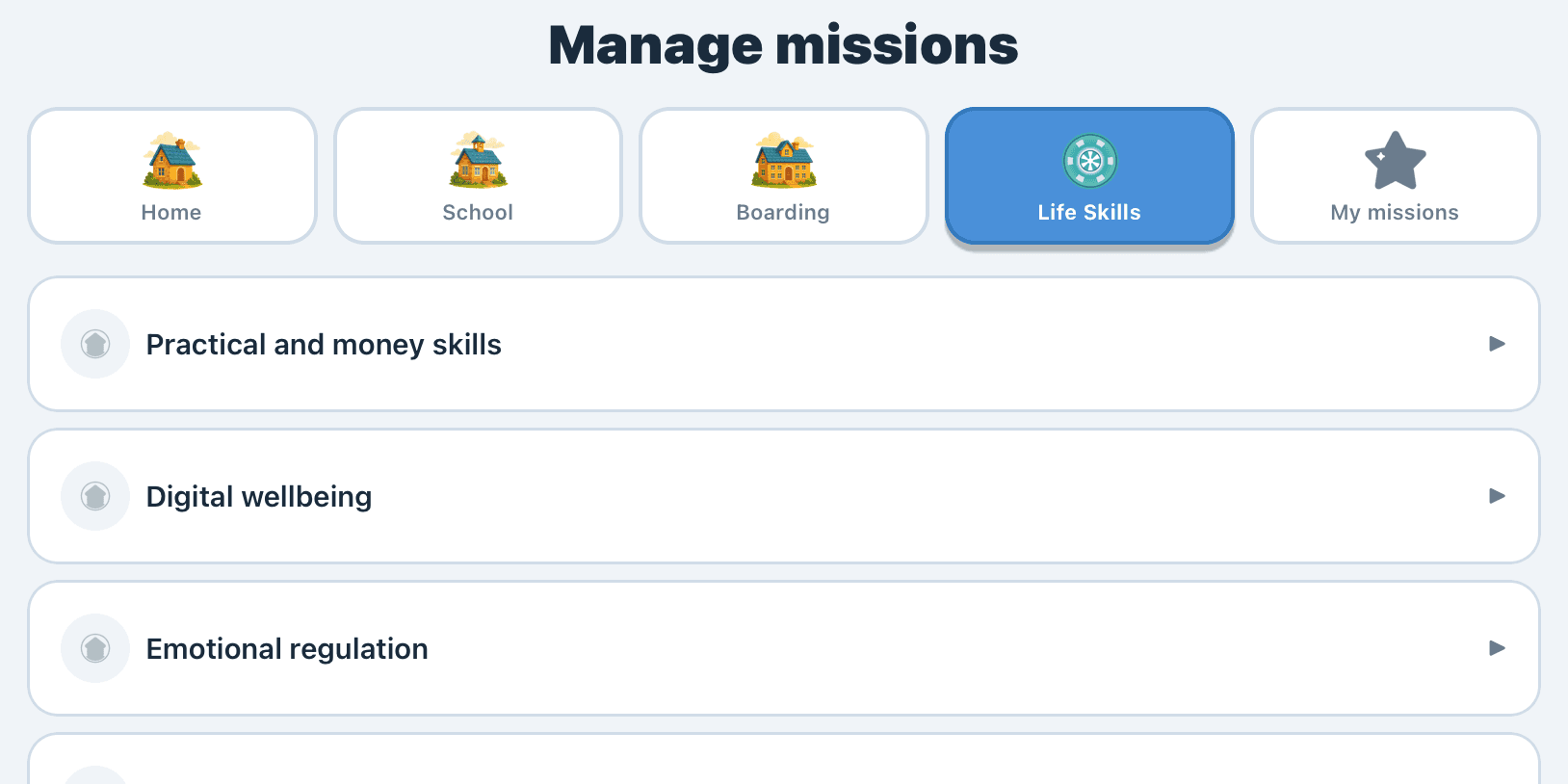
“Transversal” category
Beyond buildings, cross-context themes: practical and financial autonomy, digital hygiene, emotional regulation, social relationships, health, safety.
What we refuse, on principle
No user account to create, not for the adult, not for the child.
No data sent to a third-party server. Everything stays on the device.
No advertising analytics, no third-party identity provider, no advertising cookies.
Transparency
What Evotonomia does not do.
The product's limits matter as much as its features. Here is what you will not find in the app, by design choices tied to the offline-first philosophy.
No cloud sync between adults. Sharing happens through a JSON backup export or the planner PDF.
No simultaneous use across devices. An Evotonomia instance is tied to a single device.
No AI-generated content. All missions and routines are explicitly built by the referring adult.
No voice recognition, no text-to-speech. The child interacts by touching the screen.
No advanced statistical reporting. Counters are raw, no aggregates and no cohort comparisons.
No diagnostic evaluation. No screening, no assessment, no automated scoring.
For professionals
A tool built with and for the field.
Evotonomia is usable in a clinic, classroom, institution or at home. The project listens to the professionals who integrate it into their daily practice.
Professions concerned
Speech and language therapists, paediatric occupational therapists, special educators, teachers in inclusive classrooms, medical-educational institutes or specialised primary education, support staff. The diversity of contexts (clinic, classroom, home, boarding school) shapes the evolution of the tool.
Your feedback shapes the app
Spotted something missing, an idea, a use case the app does not yet cover? The team reads every message, and most feedback directly influences the next versions of the application.
The app
The same routines, in the adult's pocket
Evotonomia puts what you have just read into practice: missions broken into illustrated steps, a printable schedule and adjustable rewards.
- €8.49 once, no subscription
- Offline, no account
- Schedule exportable as PDF