Guide
Making time visible: timers, cues and time blindness
Updated August 25, 20264 min read
Time blindness is the difficulty in sensing duration and locating events in time. It is common with ADHD, and it explains far better than any lack of willingness why a child leaves late or cannot stop. The answer is not to repeat the time, it is to make time visible.
What not feeling time pass actually means
For many children, ten minutes of play and an hour of play feel alike from the inside. It is not that they do not know what an hour is, it is that they have no reliable sensation of duration passing. Telling a child who cannot perceive time to hurry up asks them to correct information they do not have.
The same difficulty shows up the other way round: anticipating that an activity is about to end. An ending announced out loud ten minutes ahead has no reality while nothing makes it tangible.
The visual timer, and how to use it
A visual timer shows the remaining time as an area, not as digits. The coloured zone shrinks and the child reads their progress at a glance without telling the time. It is the cue that produces the most effect for the least effort.
- Put it in the field of view, not behind the child or on a distant worktop.
- Use it to make a duration tangible, not as a pressure countdown.
- Say what happens when it reaches zero before starting it. A timer with no announced next step creates anxiety.
- Avoid using it for everything: kept for the moments that genuinely matter, it keeps its value as a signal.
Evotonomia offers a circular countdown timer among the child's activities, plus a stopwatch that can be enabled mission by mission when duration is part of the goal.
Announce transitions rather than imposing them
Most conflicts blamed on time are really transition conflicts. The child is not refusing to leave, they are refusing to be interrupted without warning. Two announcements are usually enough to change the dynamic.
A warning from a distance
“When the timer is halfway, we tidy up.” The child can organise the end of what they are doing instead of having it happen to them.
A warning close to the end
A short signal, always the same one, just before the end. The consistency of the signal matters more than what it is.
A next step already visible
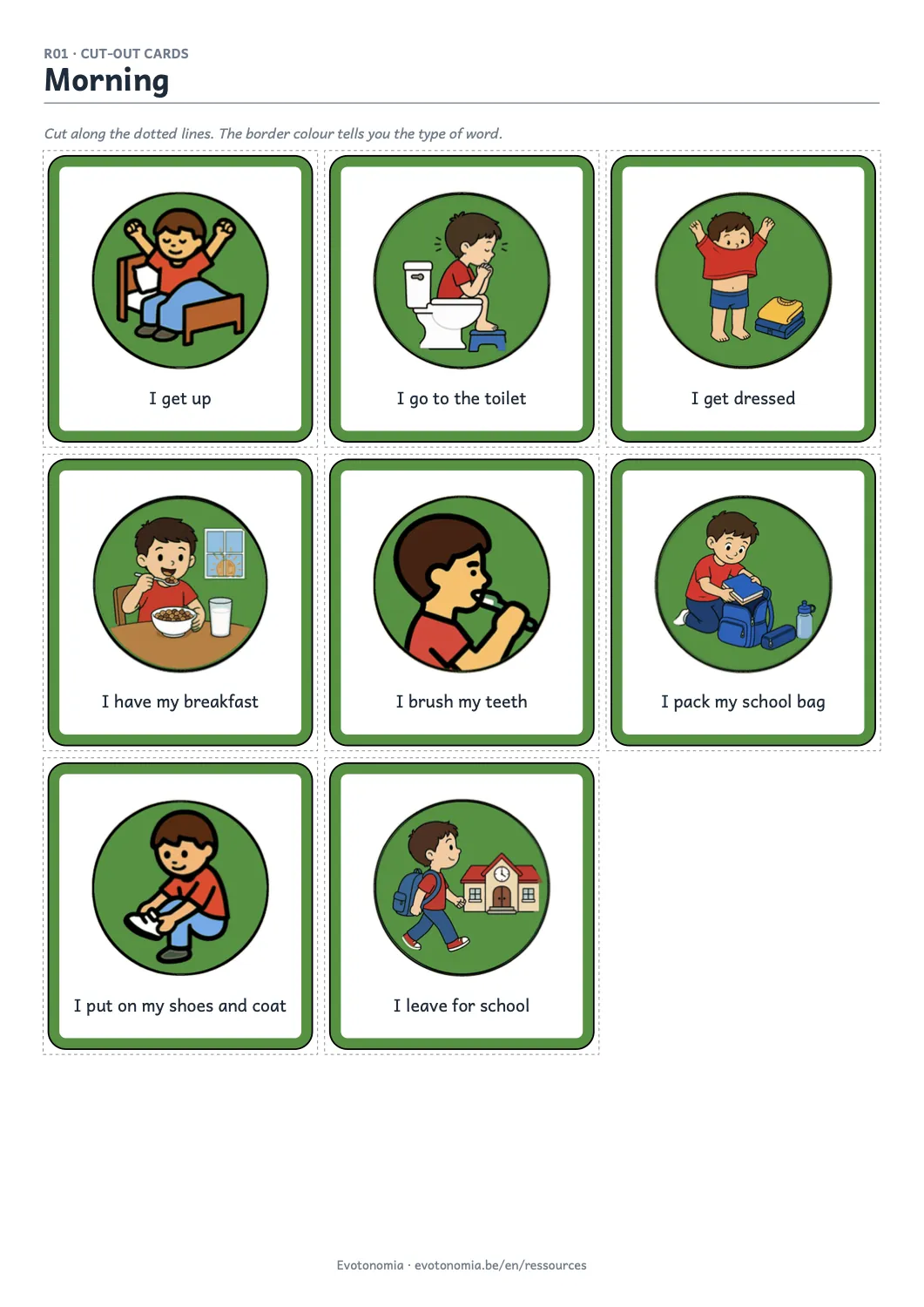
On the routine strip or the schedule. A transition towards something known gets negotiated far less than a transition into nothing.
Break duration down the way you break a task down
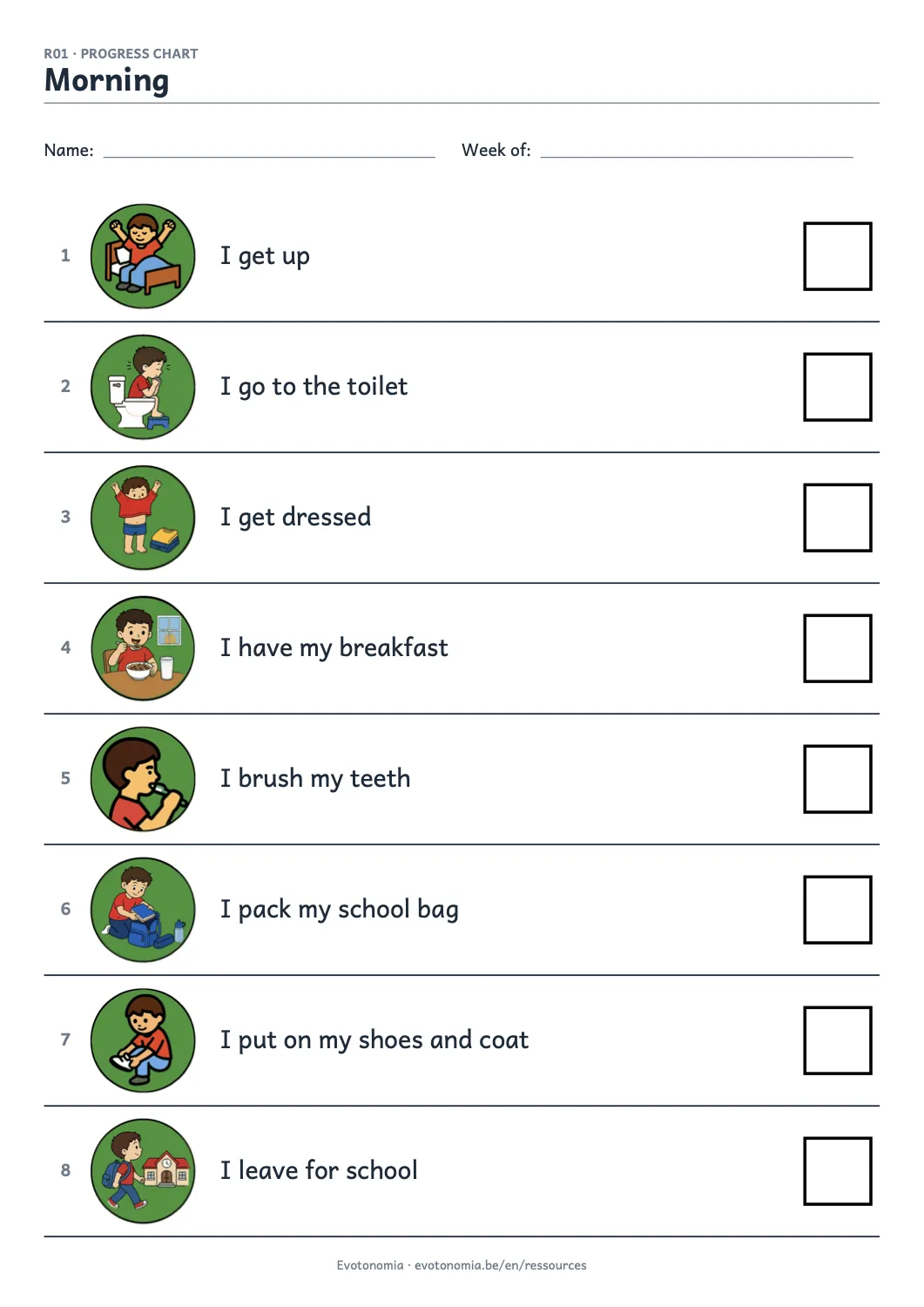
A long task is hard for the same reason a broad instruction is: nothing shows progress. Splitting a routine into visible steps partly solves the time problem, because each validated step makes an elapsed portion tangible.
A weekly tracking chart does the same thing at a larger scale: the week stops being an undifferentiated mass and becomes a series of boxes, some of them already ticked. For a child who struggles to project forward, seeing what is done beats counting what is left.