Guide
Rewards and motivation: encouraging your child without buying everything
Updated October 12, 20265 min read
A well-designed reward does not pay a child to obey. It makes visible a success that would otherwise go unnoticed. The difference comes down to three things: what you reward, what you give, and when you stop. This guide lays out a simple progression that works with a paper chart as well as with the points in the app.
Why motivation cannot be decreed
For many children, and almost all children with ADHD, today's effort for a distant result weighs nothing against what is pleasant right now. It is not a lack of will: it is a way of perceiving time and consequences. Saying "you'll see, later you'll be glad you tidied up" has no effect in the moment.
A reward brings the consequence closer to the action. It gives the child's brain an immediate reason to start, then to finish. Its role is not to last: it is scaffolding, removed once the routine stands on its own.
Three levels of reward, from simplest to rarest
Visible validation
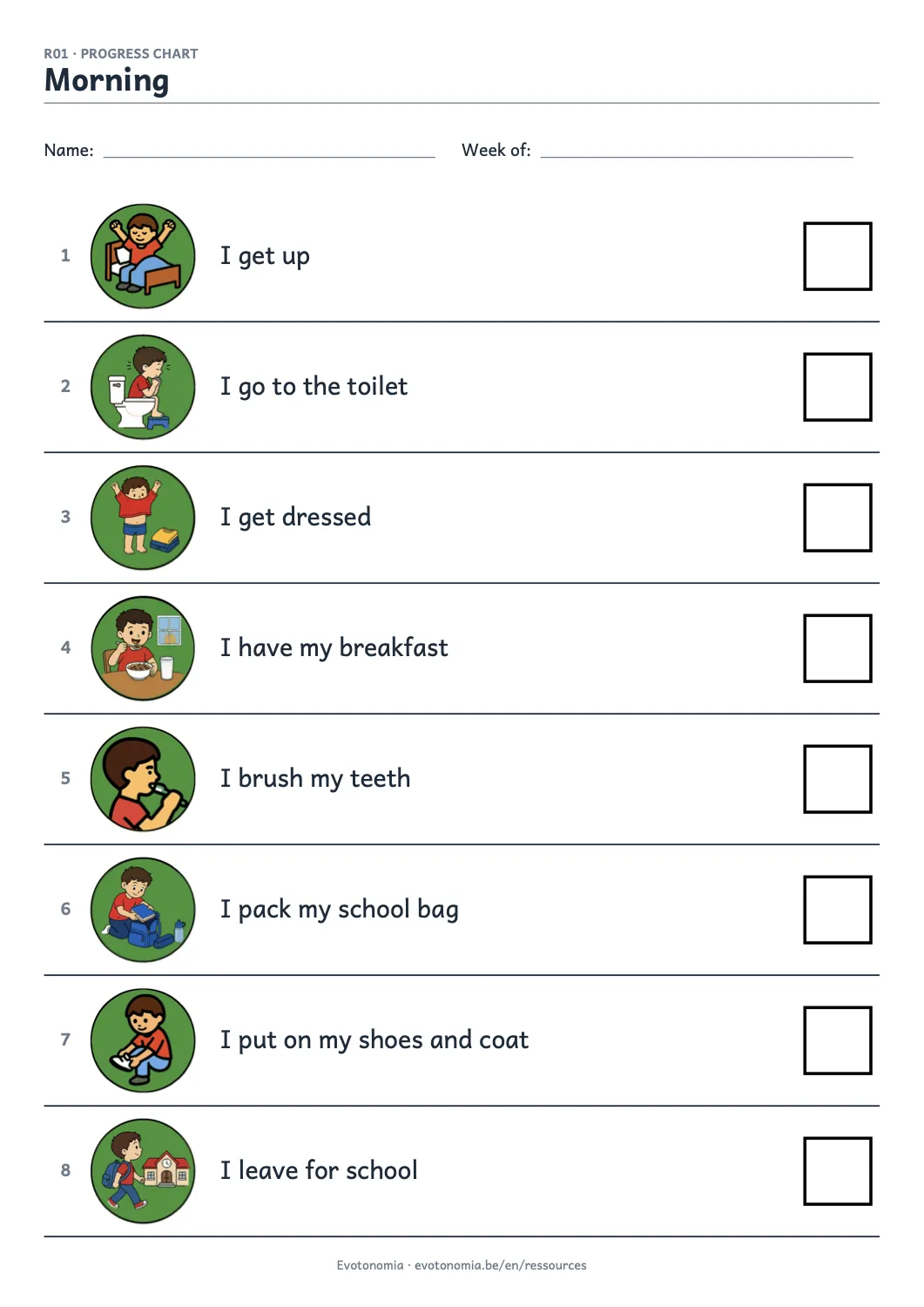
A ticked box, a step turning green, a gauge filling up. It is the most powerful and cheapest reward: it arrives immediately, at every step, and the child triggers it themselves.
Everyday privileges
Choosing dessert, picking the bedtime story, ten extra minutes of play, being first to choose a seat in the car. These rewards cost nothing, never run out, and strengthen the relationship rather than consumption.
The deferred reward
An outing, a small object, a long-awaited activity. It is earned by collecting points over several days. Keep it to one or two rewards at a time, or the child no longer knows what they are working towards.
The rules that keep the system working
- Announce the reward beforehand, never negotiate it during. A reward promised in the middle of a meltdown teaches that meltdowns pay.
- Give what has been earned, always, even if the day was difficult otherwise. Taking back earned points destroys trust in the system in one go.
- Few points, quickly earned, at the start. A child who has to wait two weeks for a first reward gave up on day three.
- One reward per routine, not per step. Steps get validated; the whole routine gets rewarded.
- The same framework for every sibling, with different goals. Fairness shows in the rule, not in the number of points.
In Evotonomia: points, achievements and rewards
The app keeps three things apart. Points are earned with each completed mission, and their value is set mission by mission. Achievements are automatic milestones, such as "five mornings in a row", that unlock without the adult doing anything. Rewards are the ones the adult creates, with their price in points: this is where you write "choose dessert" or "trip to the park".
All of it can be switched off, globally or reward by reward. For an anxious child, or one for whom the score becomes a source of stress, the daily gauge and step validation are more than enough: motivation then comes from seeing the day move forward, not from a counter.
Removing the scaffolding without the routine collapsing
A reward that lasts for months stops being one. Once a routine has held for three or four weeks without reminders, space it out: the reward comes every other day, then at the end of the week, then it disappears for that routine and moves to the next one to set up. The child keeps the visible validation, which never wears out, and the pleasure of a routine they have mastered.
The words that go with it matter as much as the reward: describe what the child did ("you packed your bag on your own") rather than judge it ("well done"). The first teaches them what they can do; the second makes them dependent on the adult's approval.