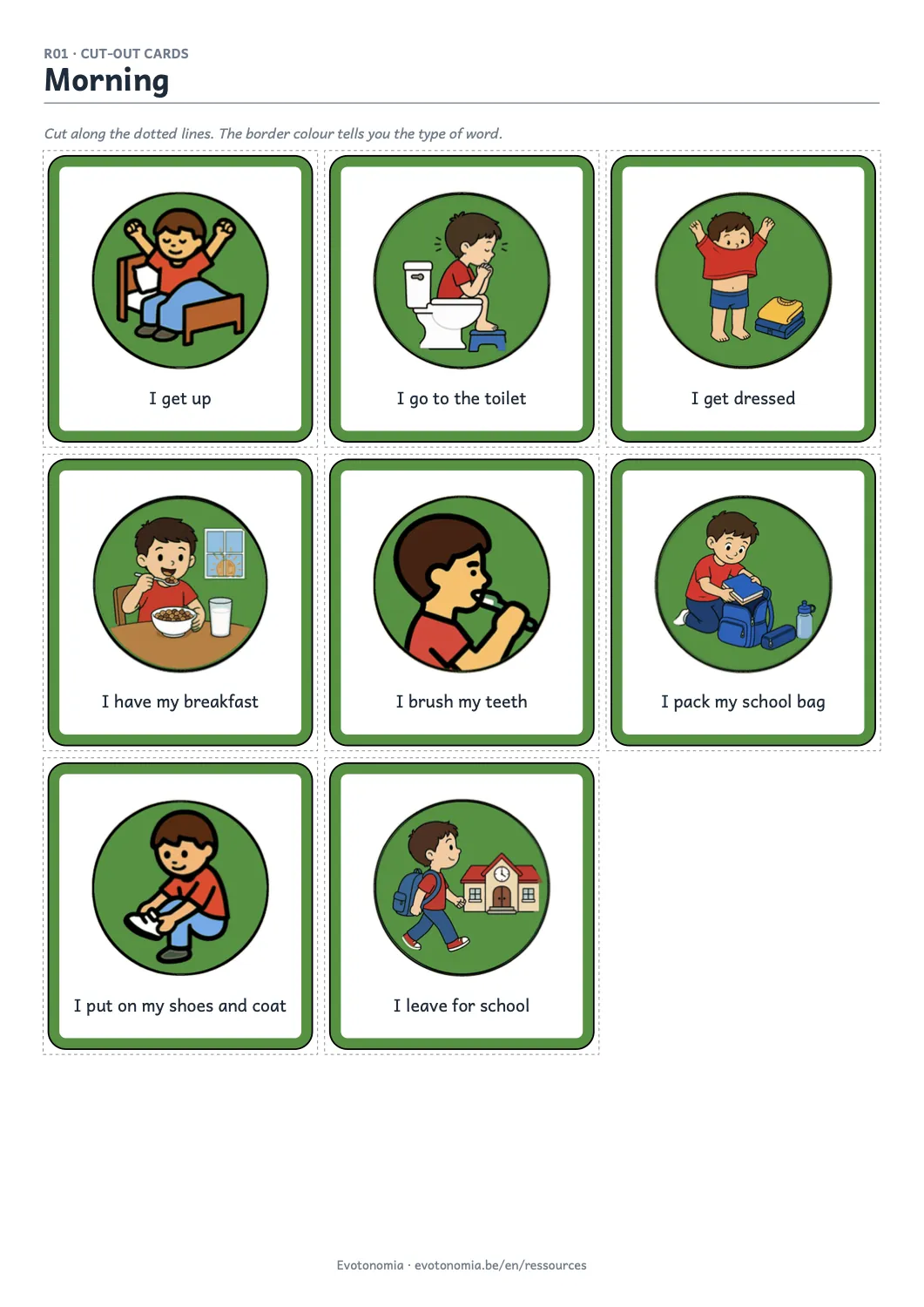
Guide
Visual schedule: making the week readable for a child
Updated August 25, 20264 min read
A visual schedule shows a child what is going to happen, in what order, without them having to ask. It is built at the scale that speaks to them: half a day for the youngest, then the day, and only the week once the day is established. Its main value is not organisation, it is reducing uncertainty.
Start at the right time scale
The most common mistake is starting with a full week. Seven filled columns are unreadable for a child who does not yet picture what a Tuesday is. The schedule becomes wall decoration, consulted by the adult and ignored by the child.
Half a day
Three to five images, from now until the next meal. This is the scale that suits the youngest and anyone for whom “tomorrow” is still abstract.
The day
Morning, midday, afternoon, evening. You move to this scale once the child correctly anticipates the end of the half day.
The week
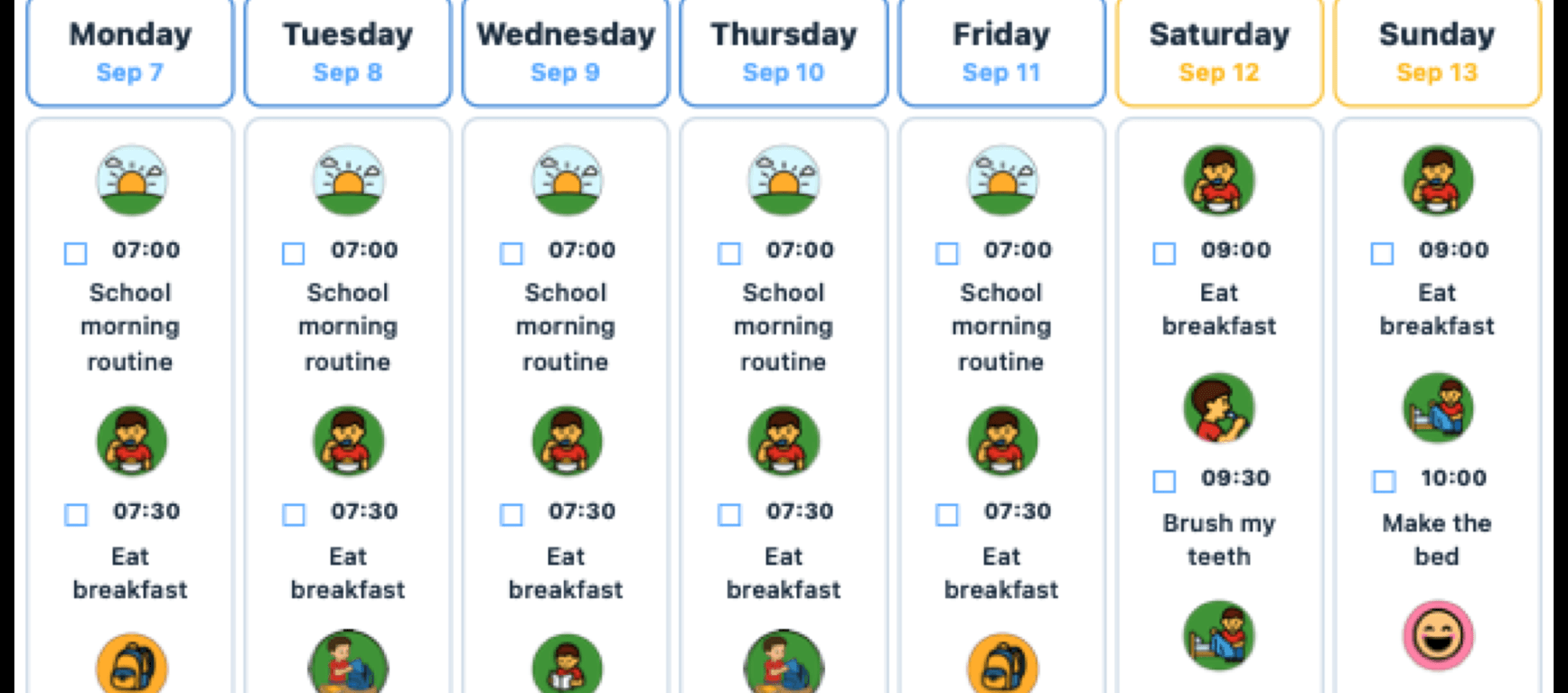
Seven columns, with today clearly marked. Useful mainly when the week varies: school, activities, moving between homes, sessions with a professional.
What goes in, and what stays out
A visual schedule is not an exhaustive diary. It carries the moments that structure the day and the ones that raise questions. Putting everything in amounts to signalling nothing.
- The fixed points: waking, school, meals, bed. These are the pillars everything else hangs on.
- The moments that change from day to day: that is where uncertainty lives.
- The moments looked forward to: they give the schedule positive value, not just a constraining function.
- Nothing else. Two to five entries a day is plenty at first.
Handling the unexpected without breaking the cue
A displayed schedule creates an expectation. When reality departs from it, the disappointment is proportional to the trust placed in the support. That is the paradox of visual cues: the better they work, the more an unannounced change costs.
- Have a “change of plan” image and use it as early as you can, even at the last minute.
- Change the schedule in front of the child rather than behind their back, so the support stays trustworthy in their eyes.
- Never remove an entry without replacing it: a hole in the day is more unsettling than a changed entry.
- On paper, keep blank cards ready. In the app, a change takes a few seconds.
The same schedule at home and at school
When a child has one support at home and another at school, they learn two systems instead of one. Sharing the same document, even an imperfect one, works better than two perfect but different tools.
That is what the PDF export is for: the schedule is built once, printed as often as needed, and handed to a teacher, an occupational therapist or the other parent without anyone installing anything or creating an account.
This guide on video
Adding a mission to the schedule
Schedule a mission on one or several days of the week, with a time if needed.
This video is in French. English versions are in production.