Guide
Printable pictograms: choosing them, sorting them, making them last
Updated August 25, 20264 min read
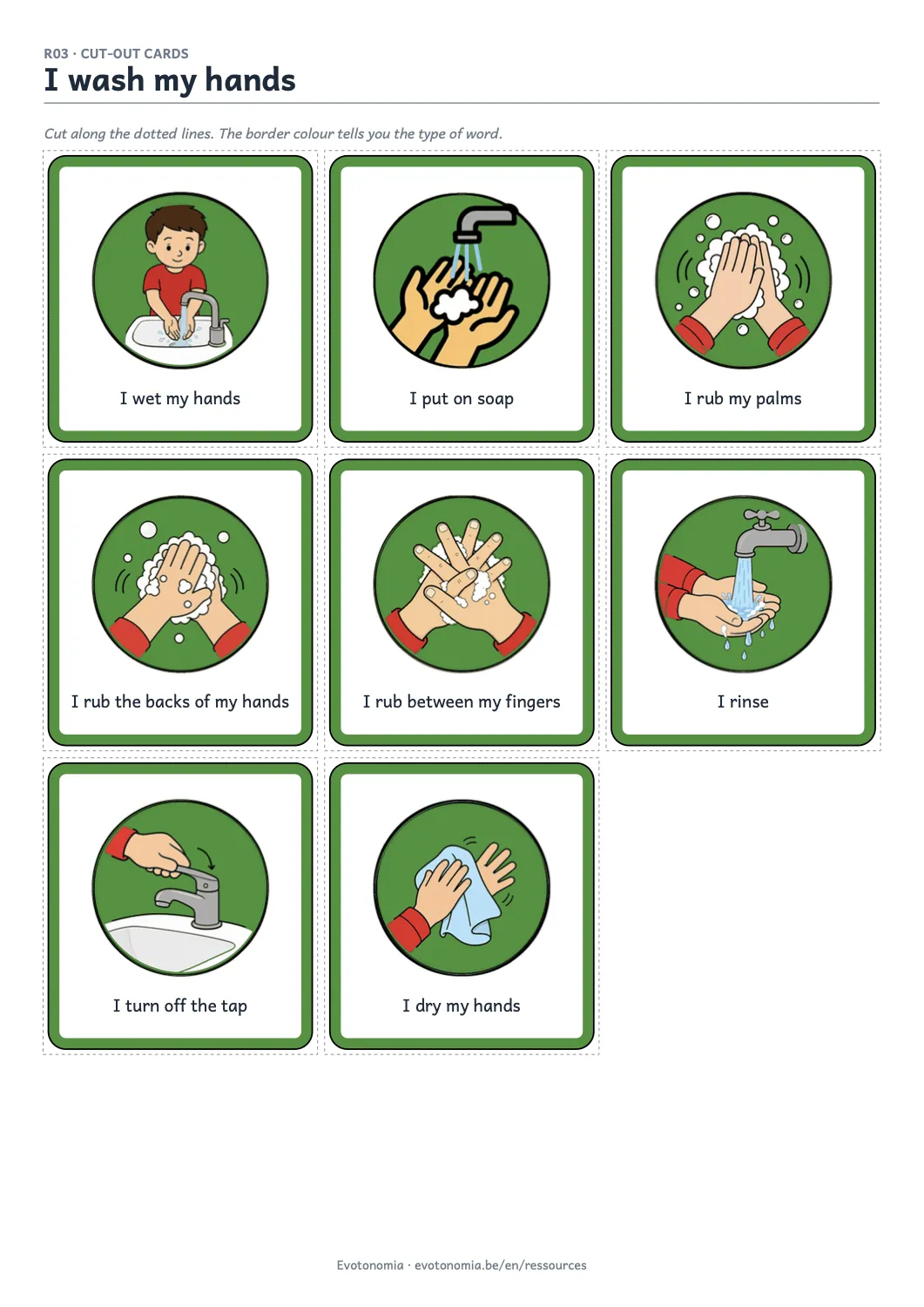
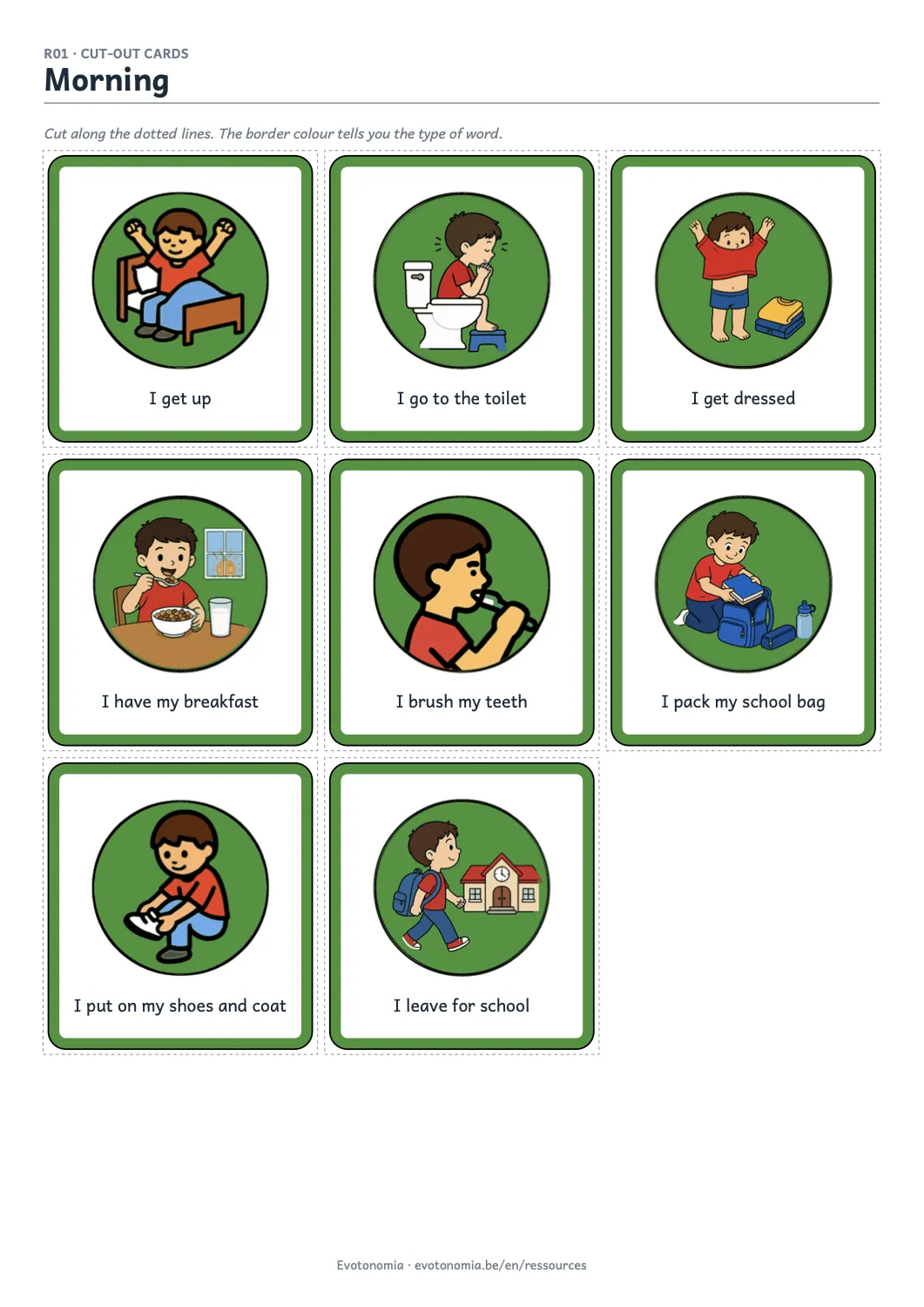
A good pictogram is one the child recognises without explanation. Style matters less than consistency: the same family of images, the same colour code, the same level of detail from one card to the next. Evotonomia's routine packs include ready-to-print cut-out cards, in colour or black and white.
What makes a pictogram work
A pictogram is not judged on how pretty it is. It is judged on how long the child takes to understand what it shows. A highly detailed image can be harder than a schematic drawing, because it offers too many elements to sort through.
- A single, centred subject, with no distracting background.
- A crisp outline that stays readable printed small or photocopied.
- A consistent level of detail across the whole set: two mixed styles force the child to relearn on every card.
- An action shown in progress, not just the object involved.
The Fitzgerald colour code, in practice
The Fitzgerald code assigns a colour to each grammatical family. It has been used in augmentative and alternative communication for decades, notably in French-speaking speech therapy. The benefit is immediate: the child identifies the kind of word by its colour, before even parsing the image.
- Green: verbs and actions, eat, sleep, tidy, brush.
- Orange: objects and nouns, the school bag, the brush, the glass.
- Pink: social words and emotions.
- Purple, yellow and grey by family: descriptors, social phrases, time and places.
Evotonomia's whole library follows this code, in the app as on the printable sheets. In practice a routine strip reads like a sentence: a run of green images signals a run of actions.
Printing, cutting, making it last
Print in black and white to test
The ink-saving version exists for this. While the sequence is not settled, there is no point spending colour on cards that will change.
Glue onto thin card before cutting
A plain paper card curls within three days. The card from a cereal box does the job perfectly.
Only laminate what stays
Once a sequence has held for two or three weeks, laminating pays off. Before that it is time spent on temporary cards.
Decide how they attach from the start
Hook-and-loop tape, magnets, or pegs on a string. How they attach decides how flexible the sequence is, far more than what is on the cards.
Where to download ready-made sequences
Evotonomia's four routine packs download free of charge, with no account and no sign-up. Each contains routine strips to put up, tracking charts, sheets of cut-out cards and a blank version to fill in, in colour and in black and white.
- My school day: mornings, the school bag, coming home.
- Evening and bedtime: the evening ritual, the shower, switching screens off.
- Hygiene and autonomy: hands, teeth, the toilet, getting dressed.
- Emotions: the thermometer, emotion cards, strategy cards.