Guide
Morning routine: building a sequence that sticks
Updated August 25, 20265 min read
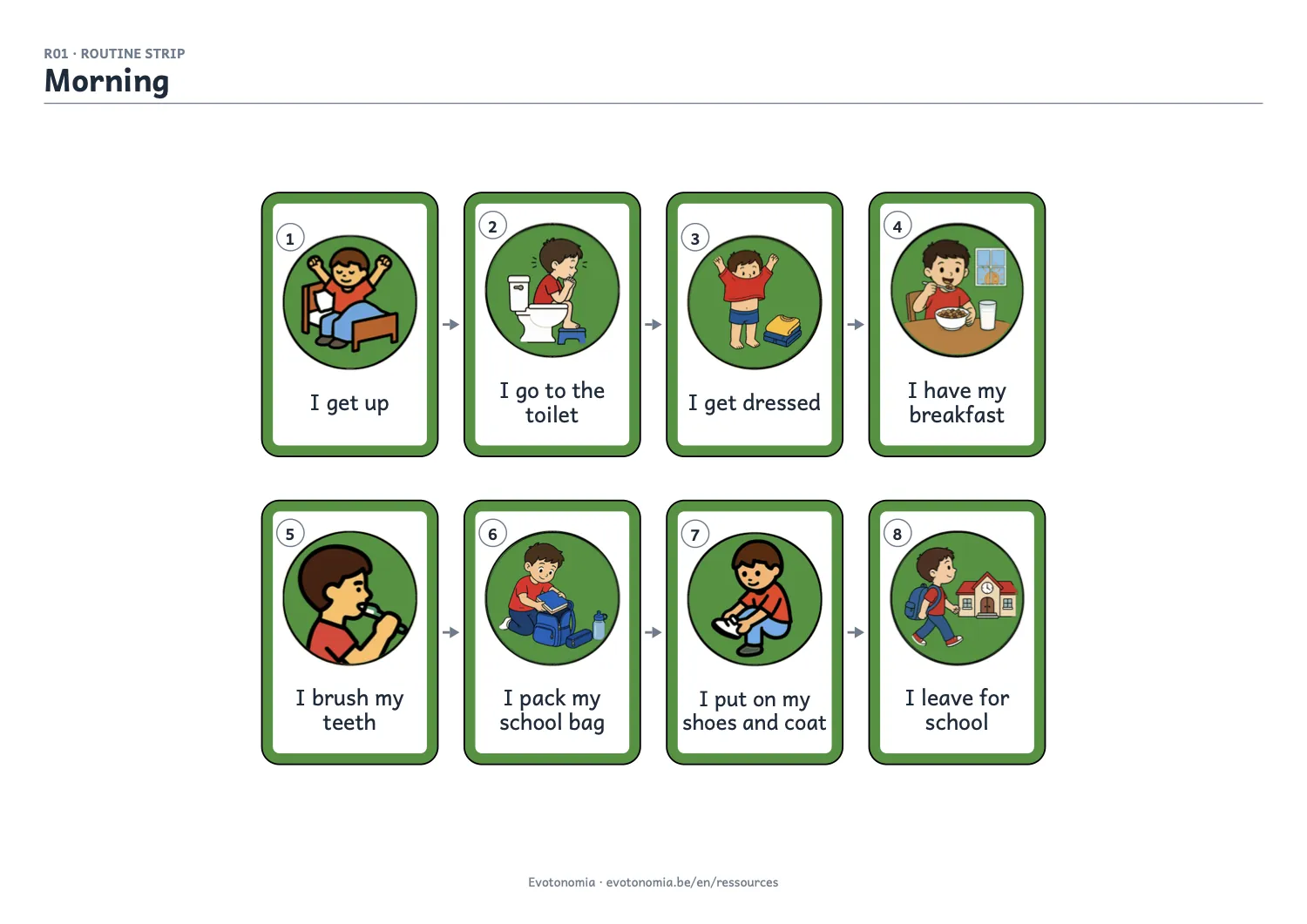
A morning routine that sticks rests on three things: a short sequence, displayed at child height, and the same one every day. A visual support does not make a child obey, it replaces the repeated instruction with information they can consult on their own. Expect two to three weeks before the sequence becomes automatic.
Why mornings resist more than the rest
Mornings stack up everything that makes a routine hard. The child is coming out of sleep, so attention is at its lowest. The sequence has many short steps with no obvious logical link between them. And it runs against the clock, with an adult who is also in a hurry, which turns every hesitation into tension.
The result is almost always the same: the adult compensates by steering with their voice. “Have you got your socks on?”, “Have you got your bag?”. Each prompt works in the moment, none of them builds autonomy, and all of them cost something to the relationship.
Breaking it down, neither too far nor too little
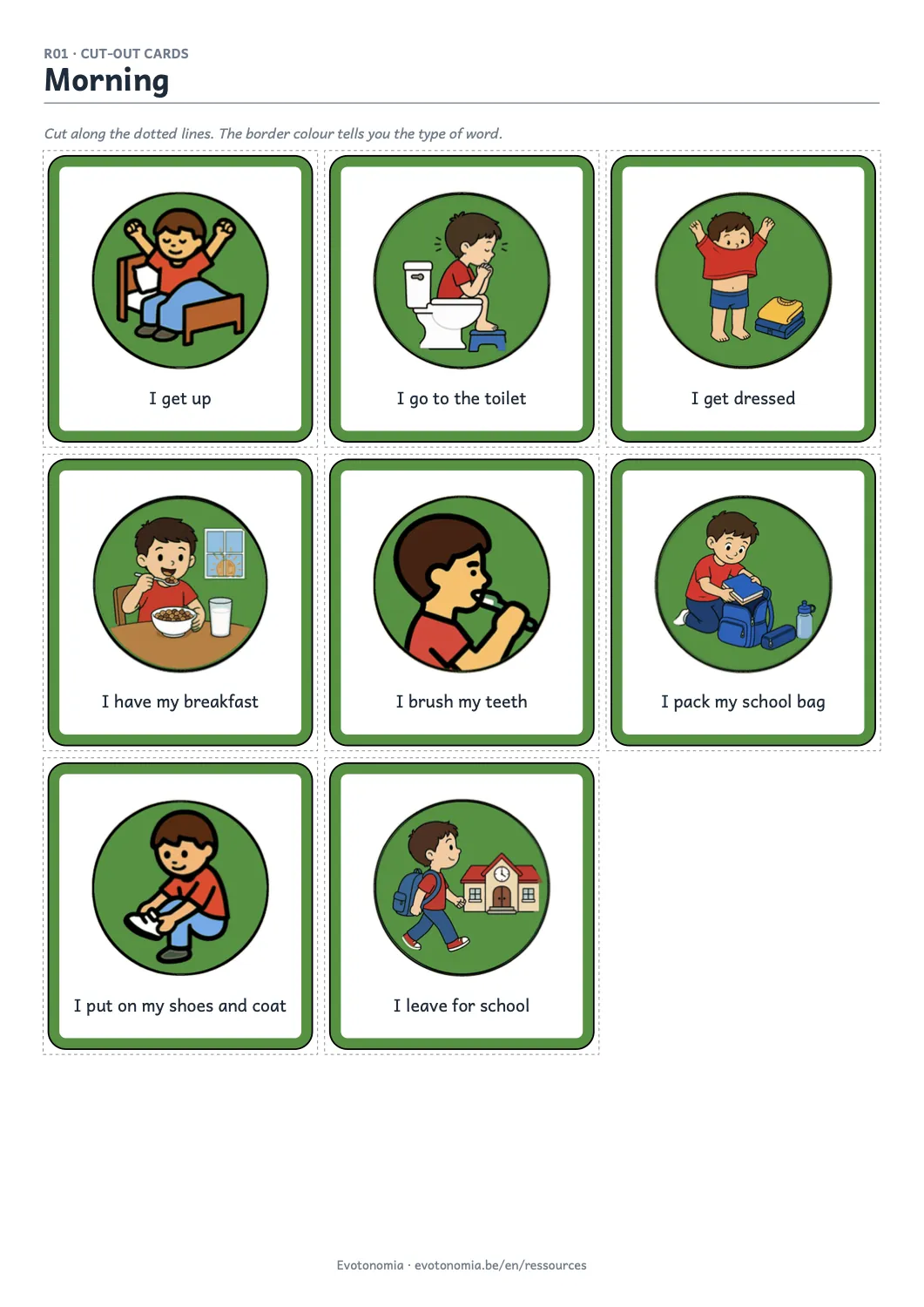
The right level of detail usually sits between five and eight steps. Below that the sequence stays implicit: “get ready” still contains a dozen actions the child has to rebuild. Above it, the strip becomes a wall of images, the child can no longer tell where they are, and ticking off a step loses its effect.
Observe before writing
For two or three mornings, note what actually happens, in the actual order. The sequence in your head and the one that unfolds are rarely the same.
Break it down where it gets stuck
If the child always stalls at getting dressed, getting dressed becomes several steps. If that part runs smoothly, it stays a single image. You add detail where it jams, not everywhere.
Name it with an action verb
“I get dressed” rather than “Clothes”. The verb says what to do, the noun only says what the topic is.
End on a step you can see
Putting shoes on, picking up the bag, opening the door. A sequence that ends on a clear action closes better than one that trails off.
Where you put it changes almost everything
A visual support only works if it is in the field of view at the moment it is needed. A strip filed away in a folder is useless. A strip taped to the bedroom door at eye level gets consulted without thinking about it.
- At the child's height, not at adult height.
- Where the routine actually happens: the bedroom for dressing, the bathroom for teeth, the hallway for leaving.
- On the natural morning path, never in a room they have to remember to walk through.
- One strip visible at a time. Three competing posters cancel out the cue.
The first three weeks
The most common mistake is judging the tool after three days. A routine becomes automatic through repetition, and repetition takes time. On the first mornings the child looks at the strip because it is new. Then the novelty fades and you often have to come back to it together. That is normal, not a failure.
- Week 1: you follow the strip with the child, pointing at the step rather than saying it.
- Week 2: you stop pointing and send them back to the strip. “Look at where you are.”
- Week 3: you only step in when things truly stop, and you let the slow patches go.
Paper, screen, or both
Paper has a decisive advantage in the morning: it is already there, permanently on, with no screen to unlock and no notification to run into. That is exactly why the routine packs exist, and many families need nothing else.
The app brings something different: step-by-step validation, the ability to change the sequence in thirty seconds without reprinting, a record of what was done, and a timer when time is the real issue. The weekly schedule then exports to PDF, which puts paper back on the wall. The two supports do not compete, they take turns.
This guide on video
The morning routine before school
From the evening before to leaving for school: the school pack, a routine scheduled at 7 am, the alert, the illustrated steps with a timer, and the gauge filling up.
This video is in French. English versions are in production.